The Myth of the Timeless Tradition
The myth of the timeless tradition helps explain why adapted customs feel ancient—and how to tell whether a revival, reinvention, or living practice suits its purpose.
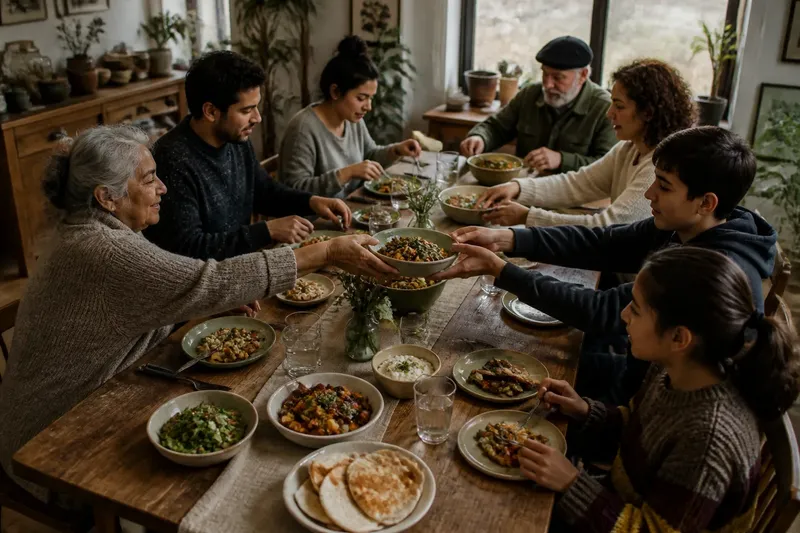
Why does an adapted tradition still feel ancient? The myth of the timeless tradition begins with a familiar scene: a family gathers around a table, repeats a familiar phrase, and passes a dish from one generation to the next. The details may have shifted—new ingredients, a different language, a changed guest list—but the repetition carries a sense of continuity. That feeling is real. It does not mean every detail has remained untouched.
Traditions often feel old because people inherit a pattern and experience it as already meaningful. Yet patterns can be revised, revived after a gap, or arranged from older pieces into a newer form. These are not interchangeable approaches. Each creates a different relationship between memory, authority, and change.
Why does an adapted tradition feel timeless?
Repetition makes a practice recognizable. A phrase said at every family meal, a song sung at a community gathering, or a yearly walk along the same route can become a signal: this is the moment when we belong to something larger than the present occasion. Recognition can arrive before anyone explains the practice’s history.
Objects and settings help. A worn recipe card, a particular melody, a familiar arrangement of chairs, or an inherited name can serve as a bridge between people who never met. The bridge need not be unchanged to work. In fact, continuity often survives because someone adjusts the practice to fit new circumstances.
That is why “old” and “unchanged” are not synonyms. A custom can carry inherited meaning while its language, participants, or materials evolve. The useful question is not simply whether a tradition is ancient, but what people are asking it to preserve—and what they are willing to alter.
Which kind of continuity are you looking at?
Three approaches help distinguish a tradition’s changing forms. A living tradition changes through ordinary use; a revival deliberately restores a practice after it has weakened or paused; an invention arranges inherited elements into a new, repeatable custom. The boundaries can overlap, but the distinctions reveal who is shaping the practice and why.
Is a living tradition supposed to stay the same?
No. A living tradition continues because people keep doing it, and their circumstances can reshape its details. The continuity lies in an understood connection between generations or participants, not necessarily in identical words, tools, or rules.
What makes a revival different from an uninterrupted custom?
A revival involves a conscious return, often after a period when the practice was absent, private, or less widely observed. People may draw on records, memories, or surviving fragments, so the revived form can be both a recovery and a new interpretation.
Can a new custom still be meaningful?
Yes. An arranged practice can become meaningful through shared repetition, especially when participants understand what it expresses and choose to continue it. Its meaning does not depend on pretending that its current form has existed unchanged for ages.
Who gets to describe a tradition as ancient?
That description may come from participants, institutions, family stories, or public accounts, and each can emphasize different things. Ask whose version is being told, whose changes are visible, and whose contribution has been left out.
When should a community let a custom evolve?
Living traditions suit people who want continuity through participation rather than exact preservation. A family may keep a holiday meal while replacing a dish that no longer fits someone’s needs; a neighborhood may retain a yearly gathering while changing its location. In both cases, the familiar purpose survives by making room for present-day participants.
Imagine a group that has shared a winter meal for years, but some members can no longer attend the evening gathering. They could shift the meal to midday and keep its familiar welcome and shared recipe. The observable result would be a gathering that more members can join, while the custom’s recognizable social purpose remains in view.
Evolution is not automatically generous, though. A change can preserve a practice for some while making others feel excluded. Before altering a custom, participants can ask what it does, who feels responsible for it, and who will be affected by the proposed change. Those questions make adaptation a shared choice instead of a quiet takeover.
Keep the purpose in view before deciding which details must remain.
When is a revival the better choice?
A revival suits people who want to reconnect with a practice that has faded, been interrupted, or survived only in fragments. It can restore a language practice, a local celebration, or a form of communal craft. The work involves more than copying a surviving description: people must decide which remembered or recorded elements matter now and how to make them usable.
Because a gap invites interpretation, honesty about the gap matters. A revived ceremony may draw on family memories, community records, and present-day needs. Naming those sources does not weaken the practice. It helps participants distinguish inherited evidence from later choices, and gives newcomers a clearer account of how the custom took shape.
A revival may be a poor fit when people want change to remain invisible or expect one person’s account to settle every disagreement. It works better when participants can discuss uncertainty without treating every variation as a betrayal. Where the practice belongs to a community with established custodians, their guidance deserves serious consideration.
Can a newly arranged custom become a tradition?
Yes, though not by borrowing the appearance of age. A new custom takes shape when people make a practice repeatable: they agree on what happens, when it happens, and what shared meaning they want to carry forward. Those choices may draw on older songs, foods, symbols, or forms of gathering without claiming that the arrangement itself is ancient.
This approach suits groups responding to a new circumstance for which no established custom quite fits. A school community, for instance, might create a yearly welcome for incoming students using a shared song and contributions from older students. If the practice continues, participants may inherit it as a familiar custom; its newer beginning can remain part of its story.
The risk is treating a fresh arrangement as old in order to make it seem beyond question. That can hide who selected its symbols and whose account of the past they represent. Describe the ingredients and the choices plainly. A custom can gain depth through use without borrowing authority from a fictional history.
How can you choose among adaptation, revival, and invention?
Start with what the participants are trying to do. If they are already carrying a practice forward and need it to fit changed circumstances, adaptation may be the clearest route. If a meaningful practice has been interrupted and people want to reconnect with it, consider revival. If the group needs a shared ritual for a new situation, an openly arranged custom may fit better.
- For adaptation: Identify the practice’s central purpose and invite affected participants to say which details help it continue.
- For revival: Separate surviving memories or records from decisions being made in the present.
- For a new arrangement: Explain why the group is creating it and which older elements it is drawing upon.
- For any option: Ask who has the authority to shape the practice and who might be left outside it.
- Before calling it timeless: Tell the difference between an enduring meaning and a form that has changed.
The myth of the timeless tradition is most revealing when it makes change disappear. Look instead for the choices that repetition can conceal: what was kept, what was added, who was heard, and what people now hope the practice will mean. That account lets a tradition belong to its past without asking the past to explain away the present.