Keepsake or Souvenir: Two Ways to Hold a Memory
Keepsake or souvenir: learn how private attachment and shared meaning shape an object’s value, and choose a place for each that honors its story.
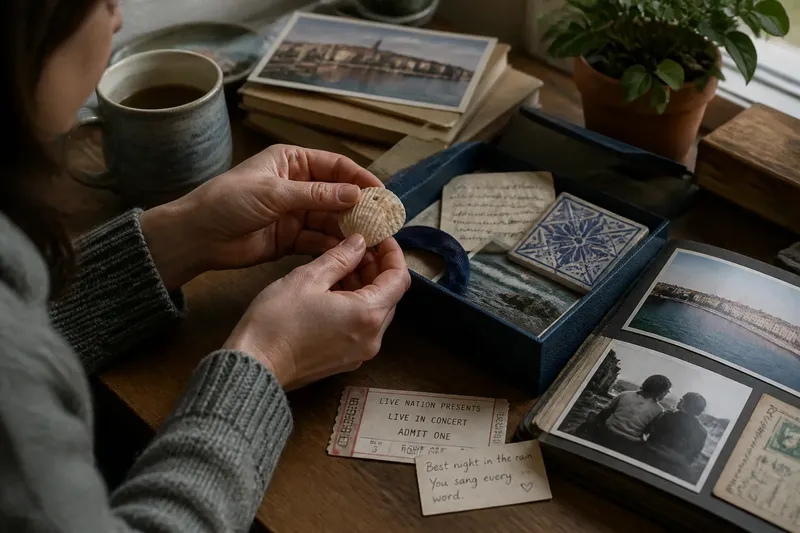
Is that chipped shell a keepsake or a souvenir? The difference often lies less in the object than in the story it is asked to carry. A keepsake holds a particular person or moment close; a souvenir makes an experience recognizable and shareable. The same shell can do both, though not always for the same audience.
What changes when an object becomes a keepsake?
A keepsake gathers value through private association. A ticket stub may recall the friend who saved a seat, while a button from a coat may bring back the person who wore it. The object need not be rare, beautiful, or even intact. Its meaning comes from a relation that may be legible only to its keeper.
That privacy shapes how people handle keepsakes. They may tuck them into a drawer, keep them in a pocket, or put them somewhere visible but not explain them to visitors. Such placement is not a verdict on the object’s importance. It can be a way to preserve a memory from becoming a performance.
Try asking what the object calls to mind before asking what it is worth. A plain paper tag might carry a fuller account than an ornate gift, because the tag is linked to a moment the keeper can still name.
Why does a souvenir invite other people in?
A souvenir is usually easier to recognize as evidence of an outing, place, or event. A printed map, a market postcard, or a mug bearing a town’s name lets someone say, “I was there,” and gives others a cue for conversation. It represents an experience through signs that are meant to travel beyond the person who collected it.
That shared legibility is useful, but it can simplify. A postcard of a harbor may stand in for a complicated visit: the weather, the long walk, the shopkeeper’s directions, the parts that never make it into the image. The souvenir does not preserve the whole experience. It offers a small, portable version that other people can understand.
A souvenir can still become deeply personal. Imagine you bring home a blue ceramic tile from a day trip after a relative helps you find it at a crowded market. The tile first signals a place to visitors; later, its chipped corner may call up that relative’s patience and laughter. Its public meaning remains, while a private one gathers around it.
How can you tell which role matters here?
Look at the object’s audience, its story, and the way it is used. These clues are not rigid categories; they help explain why two similar objects can matter differently.
- Ask who can read it. A landmark printed on a magnet is readily understood by guests. A faded note in a familiar hand may speak mainly to one person.
- Notice what the owner tells. “I bought it on the coast” frames a souvenir. “My sister gave it to me before she moved” frames a relationship.
- Look for the object’s job. A serving bowl used at family gatherings may become a keepsake through repeated use, even if it was first bought as a travel memento.
- Pay attention to display. A shelf arranged to show places visited makes a collection public-facing. A small box opened only on quiet occasions suggests a more intimate role.
- Leave room for overlap. If both place and person matter, describe both rather than forcing the object into one category.
These are observations, not tests of authenticity. The owner’s account can change, and an object’s meaning can shift with it.
What questions help explain an object’s meaning?
Can one object be both a keepsake and a souvenir?
Yes. A souvenir may begin as a public sign of a trip and acquire personal associations later. Its two roles can coexist, or one can become more important as the story changes.
Does a keepsake need to be displayed?
No. Keeping an object in a box, book, or pocket does not make its meaning weaker. Privacy may be part of how the owner cares for the memory it carries.
Can an ordinary object become a keepsake?
Yes. A receipt, scrap of ribbon, or kitchen utensil can gather meaning through a relationship or remembered event. The object’s modest appearance does not limit the story attached to it.
What makes a souvenir meaningful to someone who never visited?
The owner’s story can give it significance beyond the place it represents. A child who hears how a carved bird was chosen may value the account of the choice as much as the bird itself.
Where should you keep an object with two stories?
Let its use guide its place. A souvenir intended to prompt conversation can sit among books, postcards, or objects from other trips. A keepsake that matters most in a private moment may belong somewhere easy to reach without making it part of a display.
Say you have a concert ticket that reminds you both of a city you visited and of the friend beside you. You might put it in a photo album with the trip’s postcards, then add a short note identifying the friend and the song you both remember. The album makes the shared setting visible; the note keeps the personal connection from disappearing into a generic travel story.
When passing an object to someone else, include the part of its story that would otherwise be lost. A few words on a card can distinguish “a souvenir from the harbor” from “the shell we picked up together after missing the bus.” That small act helps the next keeper see both what the object represents and why this particular one mattered.
Keepsake or souvenir is not a permanent label. If you want to understand an object’s value, look for the balance between its recognizable public story and the private attachment that makes it irreplaceable to someone. Keep the story close to the object, and its meaning has a better chance of traveling with it.