Reading a Museum Label: What Fits in a Few Lines
Reading a museum label with three distinct passes helps separate what an object is from its history and the interpretation guiding your attention.
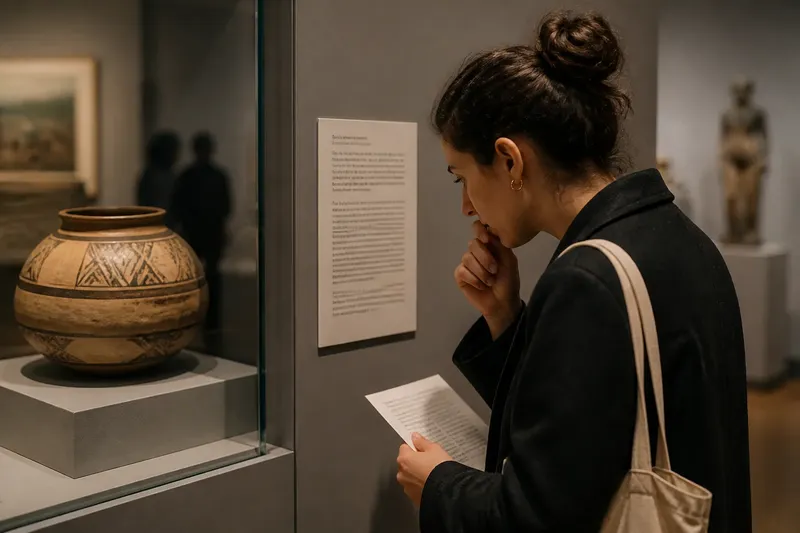
Reading a museum label can feel like trying to catch a whole argument while standing in a doorway. A small card beside a carved bowl, protest poster, or brass instrument may name the object, explain its past, and steer your response in a handful of lines. Read it in three passes—description, context, and framing—and you can tell what the label establishes, what it supplies, and what it asks you to see.
1. What can you identify from the object description?
Start with the words that identify the thing in front of you. A label might call it a “ceramic vessel,” a “commemorative medal,” or a “hand-printed notice.” Such terms do more than provide a name: they place the object in a category. That category can make certain details easier to notice and others easier to miss.
Look for the material, form, method, maker, or intended use. A description such as “woven reed basket” gives you material and construction, while “basket used to carry market goods” adds a purpose. Notice which details are stated plainly and which are absent. A label may identify a maker but not explain how the museum knows who made it; it may describe a surface as “worn” without saying when or how it became worn.
Then compare the wording with the object itself. Is a bright patch described as paint, or is it simply visible? Does the label call a mark a signature, a repair, or damage? Those are different claims. A descriptive sentence can contain interpretation too, especially when it assigns intention or meaning.
Say you are looking at a small wooden box with a metal clasp. The label calls it a “document case,” but gives no account of its owner. You can reasonably take the object’s proposed function as part of the museum’s identification, while keeping the owner’s story open. The distinction is useful: one claim names a likely use; the other would need evidence not supplied by the visible object.
First ask: what does the label let you see, and what does it ask you to accept?
2. What context does the label supply?
Context connects an object to people, places, practices, and conditions beyond its display case. A label might mention a workshop, a household, a ceremony, a trade route, or a political campaign. These details can explain how an object entered someone’s life and why it matters beyond its material form.
Read for relationships, not just background facts. “Made in a coastal workshop” gives a location. “Made in a coastal workshop that supplied ships” connects production to a wider activity. “Used by sailors” adds a group of users. Each link broadens the object’s story, but each also raises a question: whose work, access, or experience has been included?
Watch how the label handles uncertainty. Phrases such as “likely made for,” “possibly used in,” or “attributed to” signal that the museum is presenting a qualified claim. They are not decorative hedges; they tell you how firmly the institution stands behind a statement. If the label states a connection without qualification, that tells you how it is being presented—not necessarily every reason for the connection.
Context also has edges. A short label cannot carry a full biography, account of a community, or chain of ownership. It may name the person who donated an object while leaving earlier custody unexplained. It may explain a ceremony without identifying disagreement about who could take part. Notice the boundary rather than treating the few lines as the complete record.
A practical move: underline mentally every person, place, and group named, then notice who remains unnamed.
3. How does the label frame your interpretation?
Framing is the angle from which the label invites you to understand the object. A label might present a garment as evidence of skilled craft, a sign of social rank, a tool of resistance, or an example of changing taste. These readings are not interchangeable. Each makes some features feel central.
Pay attention to the verbs and adjectives. “Decorated,” “displayed,” and “worn” describe different relations between an object and its users. Words such as “rebellious,” “refined,” or “traditional” can carry an evaluation as well as a description. Ask what visible or contextual detail supports that wording. If the label calls an image “defiant,” does it explain whose authority the image challenged, or leave that relationship implied?
Framing also appears in what the label puts first. A maker’s name at the opening may foreground authorship. A reference to a ceremony may make collective use the main point. A sentence about a collector may shift attention toward acquisition. The order does not settle the object’s meaning, but it does guide the first path through it.
Imagine a gallery label beside a hand-painted sign. It describes the sign’s lettering, names the neighborhood where it was displayed, and calls it “a voice of local resistance.” The first statement directs attention to technique, the second provides a setting, and the last offers a political reading. You might ask what made that resistance local and who understood the sign that way. The label’s interpretation becomes easier to assess when you can separate it from the claims beneath it.
4. Why do museums use such short labels?
A label has to work beside an object, among other displays, for visitors who may pause briefly or read at length. Its limited space makes selection unavoidable. Curators choose which identifying details, pieces of context, and interpretations can help a visitor make sense of the encounter. The result is an edited account, not a miniature catalogue.
That compression can be generous: a clear material description may help you look closely, while a sentence about use gives the object a human setting. It can also make institutional choices less visible. When a label names one maker, for instance, you may wonder whether the work involved other hands. When it presents one interpretation without alternatives, you can ask whether the evidence supports that confidence.
Shortness alone does not prove that a museum is hiding information. The useful question is what the available space has been used to prioritize. A concise label that clearly distinguishes a documented detail from a suggested reading gives you more to work with than a longer label that blurs the two.
5. What questions help you read a museum label closely?
What is directly visible?
Separate features you can inspect—material, shape, color, marks—from claims the label makes about their origin or purpose. This keeps the object itself in view while you consider the museum’s description.
Which claims are qualified?
Look for words that mark uncertainty, such as “possibly” or “attributed to,” and note which statements are presented without qualification. The wording offers clues about how the label distinguishes a firm identification from a proposal.
Whose experience appears?
Identify the makers, owners, users, and communities named, then notice who is missing from the short account. Absence does not tell you why someone was omitted, but it can point to a useful question for a longer caption, catalog entry, or museum staff member.
What response does the label invite?
Notice whether the wording encourages admiration, concern, curiosity, or criticism. Then ask which details support that response and whether another reading is also plausible.
6. How can you carry the three passes into the gallery?
You do not need to turn a museum visit into an examination. Try a quick sequence: read the object name and description, look back at the object, then read the context and interpretation. On a second look, check whether the label’s language made you notice a feature you had missed or overlook one you can now see.
If a label refers to a longer story, look for a nearby wall text, audio guide, catalog entry, or online collection record. Those sources may provide more detail, though they will also make choices about emphasis. A staff member or gallery guide may be able to clarify a term or point you toward further information.
Reading a museum label this way does not require you to reject its account or accept it whole. It lets you distinguish the object’s description from the setting built around it and the interpretation that ties those pieces together. The next time a few lines make a large claim, read them once for what is named, once for what is connected, and once for the point of view doing the connecting.